
Whether you're pouring your first soy candle or scaling a soap business, the fragrance oil you choose shapes everything — from how your product smells on and off the flame, to how you label it, price it, and market it. This guide walks you through every factor that matters so you can make an informed decision for your craft.
Understanding the Three Fragrance Categories
Before comparing natural and synthetic options, it helps to know that the fragrance world actually has three primary categories you'll encounter as a maker.
Essential Oils
Essential oils are concentrated plant extracts obtained through steam distillation or cold pressing from flowers, bark, leaves, roots, or rinds. They are completely natural and can be declared 100% pure as long as no additional ingredients are present. Essential oils have been used for centuries — from ancient Arabian distillation to modern aromatherapy — and they carry genuine therapeutic potential.
Natural Fragrance Oils (Natural Isolates)
Natural fragrance oils sit between essential oils and synthetics. They are created by extracting individual aromatic molecules — called isolates — from essential oils, plants, and flowers, then recombining them into complex scent profiles. This approach lets perfumers craft scents like vanilla, coconut, or fresh linen using only naturally derived components, opening up creative territory that pure essential oils alone cannot reach.
Synthetic Fragrance Oils
Synthetic fragrance oils are aromatic compounds engineered in a laboratory. They are designed to mimic natural scents or create entirely new ones that don't exist in nature. For example, true fruit scents (other than citrus), chocolate, and amber notes are almost exclusively produced through synthetic chemistry. These oils are purpose-built for performance in candles, soaps, and cosmetics.
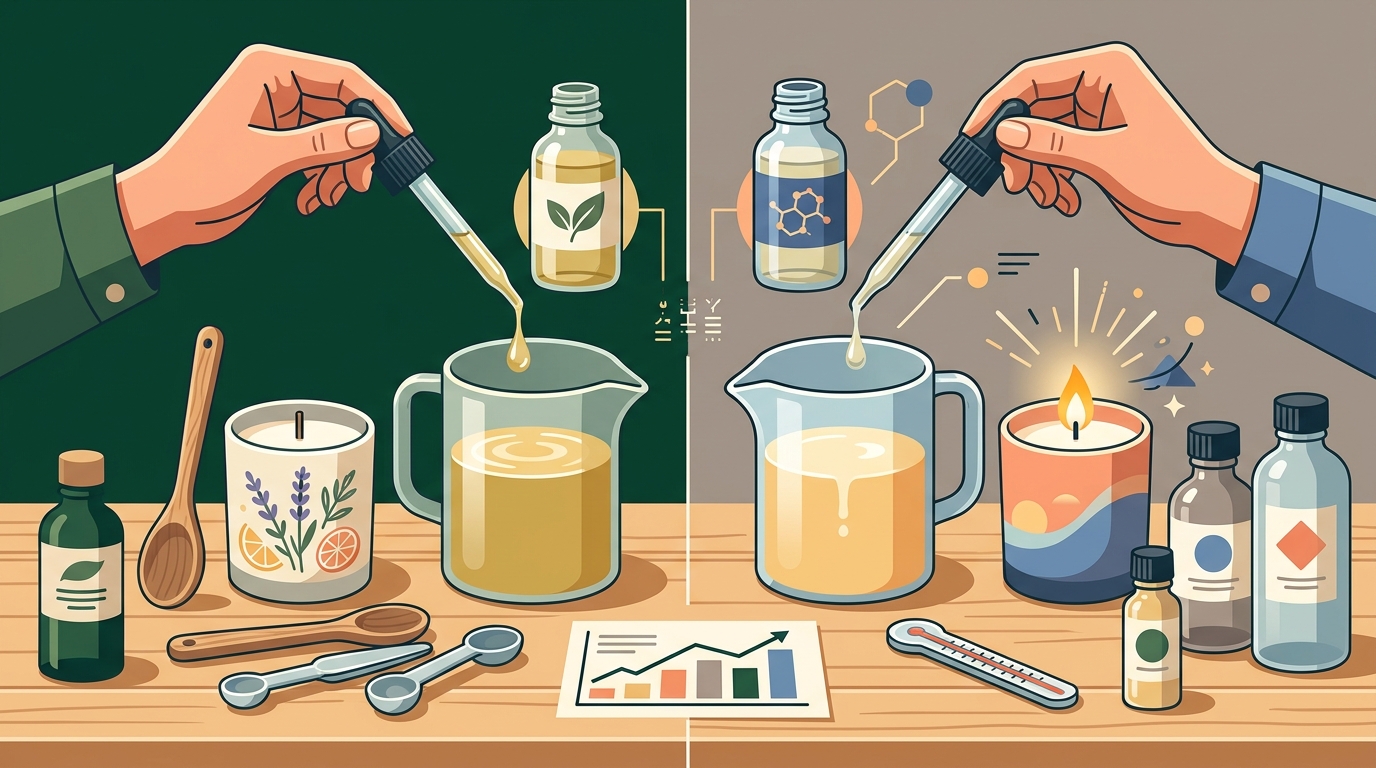
How Each Type Is Made: Sourcing and Production
Plant-Derived Extraction
Natural fragrance materials come from cultivated crops. The scale of raw material required can be staggering — it takes roughly 60,000 roses to produce a single ounce of rose essential oil. Many of the plants used for popular essential oils, including sandalwood, rosewood, and atlas cedarwood, face conservation concerns due to over-harvesting.
Lab-Based Synthesis
Synthetic fragrance compounds are created by chemists who map the molecular structure of a target scent and then build it from chemical precursors. This process allows for exact replication batch after batch. Some synthetic compounds are bio-identical to those found in plants; the difference is the production method, not the end molecule.
The Blended Approach
Many of the best-performing fragrance oils on the market are sophisticated blends of natural and synthetic components. These hybrid oils combine the authentic depth of botanical extracts with the stability and throw of engineered molecules — giving makers flexibility without forcing a binary choice.
Performance in Candle Making
Performance is where the differences between natural and synthetic fragrance oils become most tangible for candle makers.
Scent Throw (Hot and Cold)
Synthetic fragrance compounds are engineered for enhanced stability, which typically results in a stronger, longer-lasting scent throw throughout a candle's burn time. Natural and essential oil-based fragrances sometimes produce a less powerful throw because their molecular structure is less stable under heat. Lighter natural scents — especially citrus — can evaporate quickly in hot wax, sometimes leaving a noticeably weaker candle.
Burn Behavior
Synthetic fragrance molecules are intentionally designed to burn in a candle and tend to burn true, clean, and effective. Some natural oils can produce a slightly scorched or altered aroma when exposed to high heat, which may indicate the oil itself is combusting rather than simply vaporizing. Testing your fragrance load at multiple percentages is essential regardless of oil type.
Batch Consistency
Natural materials can vary from one harvest to the next, much like vintages of wine. A lavender essential oil from France one year may smell subtly different the next. Synthetic oils deliver identical scent profiles in every batch, which is a major advantage for makers building a brand that depends on product consistency.
Performance in Soap Making
Soap making introduces additional chemistry. During cold process soap making, the high pH of lye can alter or destroy delicate scent molecules.
- Acceleration and seizing: Some fragrance oils — both natural and synthetic — can cause soap batter to thicken rapidly. Always check supplier notes for cold-process performance data before committing to a large batch.
- Discoloration: Vanilla-containing fragrance oils (natural or synthetic) often cause soap to darken over time due to vanillin content. This is a chemical reaction, not a safety concern, but it affects aesthetics.
- Scent retention: Synthetic oils generally hold their scent better through the saponification and curing process because their molecules are engineered for stability.
Safety, Allergens, and Regulation
Safety is one of the most misunderstood areas when it comes to natural versus synthetic fragrance oils. Many people assume natural automatically means safer, but this is not always the case.
Allergen Potential
Natural fragrances tend to have a higher allergen concentration than their synthetic counterparts. Nearly all essential oils contain known allergens. Conversely, allergic reactions are often more commonly associated with natural ingredients, which is why carefully formulated synthetic versions can sometimes offer a gentler option for sensitive users.
Regulatory Standards
Reputable fragrance oil suppliers formulate their products to meet IFRA (International Fragrance Association) and RIFM (Research Institute for Fragrance Materials) standards. In the U.S., fragrance blends can legally be listed as a single ingredient — "fragrance" — under trade-secret protections. The EU requires manufacturers to disclose specific allergens on labels. Look for fragrance oils that are phthalate-free and that avoid ingredients on the California Prop 65 list.
What "Clean" and "Phthalate-Free" Actually Mean
Terms like "clean" and "non-toxic" are marketing descriptors, not regulated certifications. The most meaningful indicators of safety are specific claims: phthalate-free, paraben-free, and compliant with IFRA guidelines. At makesy, every fragrance oil is phthalate-free, and the line includes both certified natural options and synthetic formulations — all meeting the company's made better™ standard for clean, eco-conscious ingredients.
Sustainability Considerations
Sustainability is not a simple natural-versus-synthetic debate.
Environmental Cost of Natural Oils
The agricultural footprint of essential oil production is significant. Vast quantities of plant material are required. Many of the crops are grown on large commercial farms that rely on pesticides. Several popular essential oil botanicals are classified as threatened species. The carbon footprint of farming, harvesting, and distilling these raw materials can actually exceed that of lab synthesis.
Environmental Cost of Synthetics
Synthetic fragrance production uses petrochemical feedstocks and laboratory energy. However, because synthetics require far less land and biomass per unit of fragrance, their overall ecological impact per ounce is often lower — a nuance that surprises many makers who equate "natural" with "green."
A Balanced Path
Many brands adopt a blended sourcing strategy: using sustainably sourced natural isolates where they perform well, and clean synthetics where they offer better safety, stability, or environmental outcomes. This pragmatic approach lets you market honestly without overstating environmental claims.
Cost and Business Implications
| Factor | Natural Fragrance Oils | Synthetic Fragrance Oils |
|---|---|---|
| Price per ounce | Generally higher; premium botanicals like rose absolute and sandalwood are especially costly | Generally lower and more predictable across batches |
| Scent palette | Limited to what nature produces; rich in herbaceous, citrus, and resinous profiles | Virtually unlimited; can recreate any scent including fantasy notes |
| Shelf life | Typically 6–12 months for pure essential oils before oxidation affects quality | 12–24+ months with proper storage |
| Label appeal | Strong marketing story for wellness, aromatherapy, and all-natural brands | Ideal for trend-driven, complex, or gourmand scent collections |
| Wholesale availability | Supply can fluctuate with crop yields and seasons | Consistent supply year-round |
How to Decide: A Practical Checklist
- Define your brand positioning. An all-natural wellness line demands certified natural fragrance oils. A luxury home-fragrance brand may benefit from the creative range and throw of synthetics.
- Test before you commit. Always test fragrance oils at multiple usage levels in your specific wax or soap base. Natural oils and synthetics behave differently in soy versus coconut versus paraffin.
- Read the technical documents. Check IFRA certificates, Safety Data Sheets, and supplier performance notes. Reliable suppliers provide cold-process behavior data, flash points, and recommended usage percentages.
- Consider blending both. Many successful makers use natural oils for simple, botanical scents and synthetics for complex or gourmand profiles. There is no rule that says you must choose only one.
- Ask about sourcing transparency. Whether natural or synthetic, know where your ingredients come from and how they are tested.
Key Takeaways
- Natural fragrance oils are made from plant-derived isolates and carry authentic botanical character, but may have a weaker scent throw and higher allergen concentration.
- Synthetic fragrance oils are lab-created for stability, consistency, and performance, and offer a far wider scent palette at a lower cost.
- "Natural" does not automatically mean safer or more sustainable — both categories have trade-offs.
- The best approach for most makers is to evaluate each fragrance individually based on performance data, safety documentation, and brand fit rather than defaulting to one category.
- Always choose phthalate-free, IFRA-compliant fragrance oils from transparent suppliers.
Frequently Asked Questions
Are natural fragrance oils the same as essential oils?
No. Essential oils are single-ingredient plant extracts obtained through distillation or pressing. Natural fragrance oils are blended formulations made from multiple natural isolates extracted from plant materials, designed to create more complex scent profiles while remaining 100% naturally derived.
Can I use synthetic fragrance oils in soap that touches skin?
Yes, provided the fragrance oil is formulated for skin-safe applications and complies with IFRA guidelines. Always check the supplier's IFRA certificate for maximum usage rates in rinse-off and leave-on products. Phthalate-free synthetic oils from reputable suppliers are widely used in commercial soaps and body care.
Why does my natural fragrance oil smell different in the candle than in the bottle?
Essential oils and natural fragrance oils are more volatile than synthetics and may change character when exposed to heat. Lighter top notes — particularly citrus — can evaporate quickly, leaving only the base notes. Testing at different fragrance loads and adding the oil at the recommended temperature helps preserve the intended scent profile.
Do synthetic fragrance oils produce more soot than natural ones?
Soot production in candles is primarily influenced by wick size, wax type, and fragrance load — not whether the fragrance is natural or synthetic. A properly wicked and correctly loaded candle should produce minimal soot regardless of fragrance source.
What does "phthalate-free" mean and why does it matter?
Phthalates are chemical compounds historically used to make fragrances last longer. Some phthalates have raised health concerns, which is why many suppliers — including makesy — now formulate all fragrance oils without them. Choosing phthalate-free oils is a straightforward way to reduce potential risk in your finished products.
Can I blend natural and synthetic fragrance oils together?
Yes. Many professional perfumers and candle makers blend both types to get the authentic depth of naturals with the stability and throw of synthetics. Just ensure both oils are compatible with your base material and that the combined usage rate stays within IFRA-recommended limits.